7/17/2026
Ad MeasurementMERD2C
Before scaling Meta spend, verify seven numbers: your COD share, your COD completion rate, your category return rate, retained revenue per campaign, your break-even Retained MER, your unmatched-order remainder, and the seasonal return pattern ahead. Each is defined below with the method to pull it.
All seven of these come back to one thing: the Reality Gap between what your ad platform reports and what you actually keep. None of the seven are hard to pull. Most founders just haven't pulled them yet.
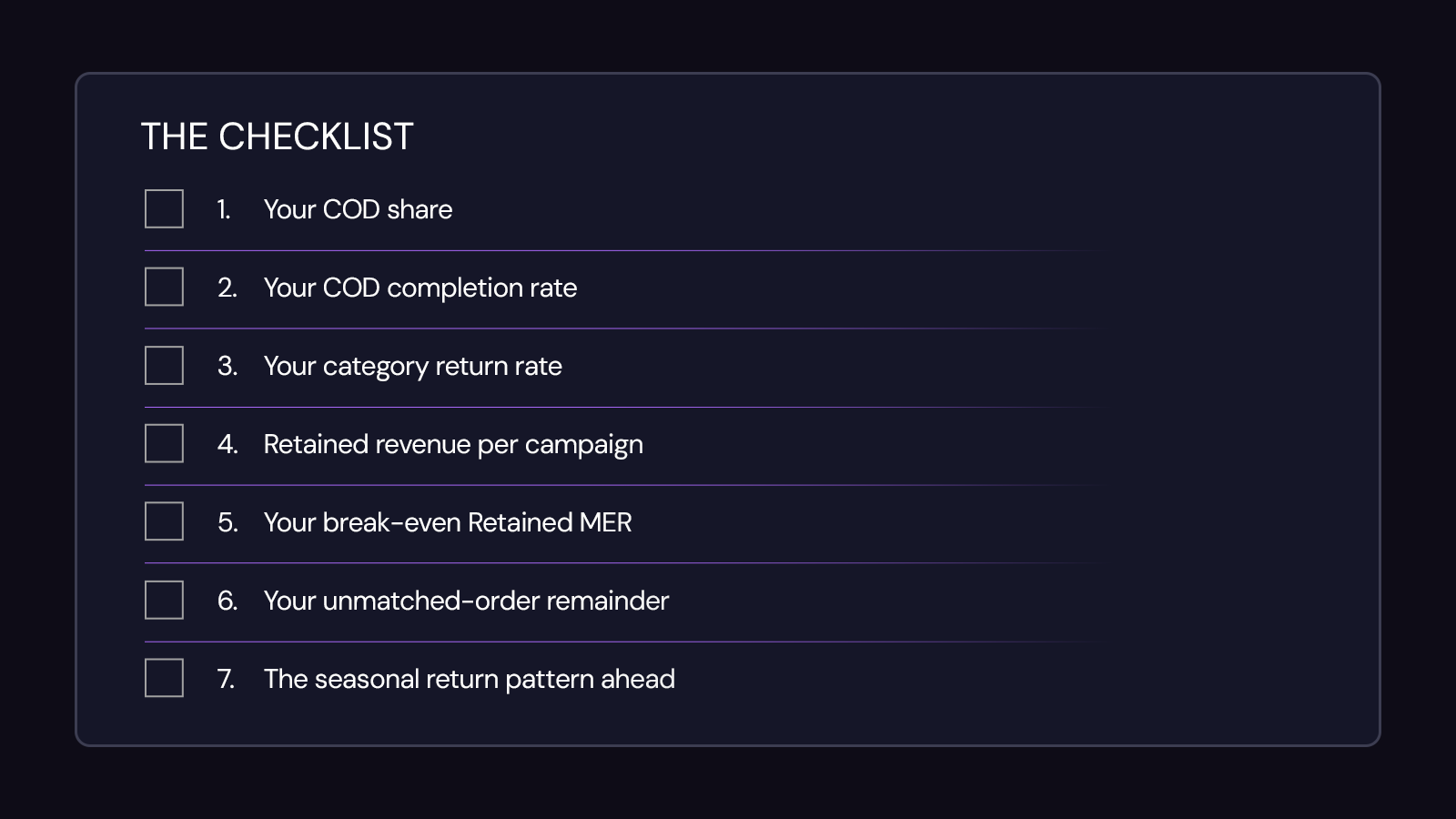
Seven numbers. Pull each one before you push more budget into Meta.
Not the market's COD share, yours. The majority of Indian D2C orders run cash on delivery, that part's well established at this point, more on why that matters for ROAS here, but your account's actual split is the number that decides anything.
Pull it this week: COD orders versus prepaid orders from your store, last 30 to 90 days. Five minutes in Shopify or WooCommerce.
The trap: assuming you're "mostly prepaid" because that's how you think of your brand, then skipping the correction on the one campaign that's actually running 70% COD in Tier 2 pincodes.
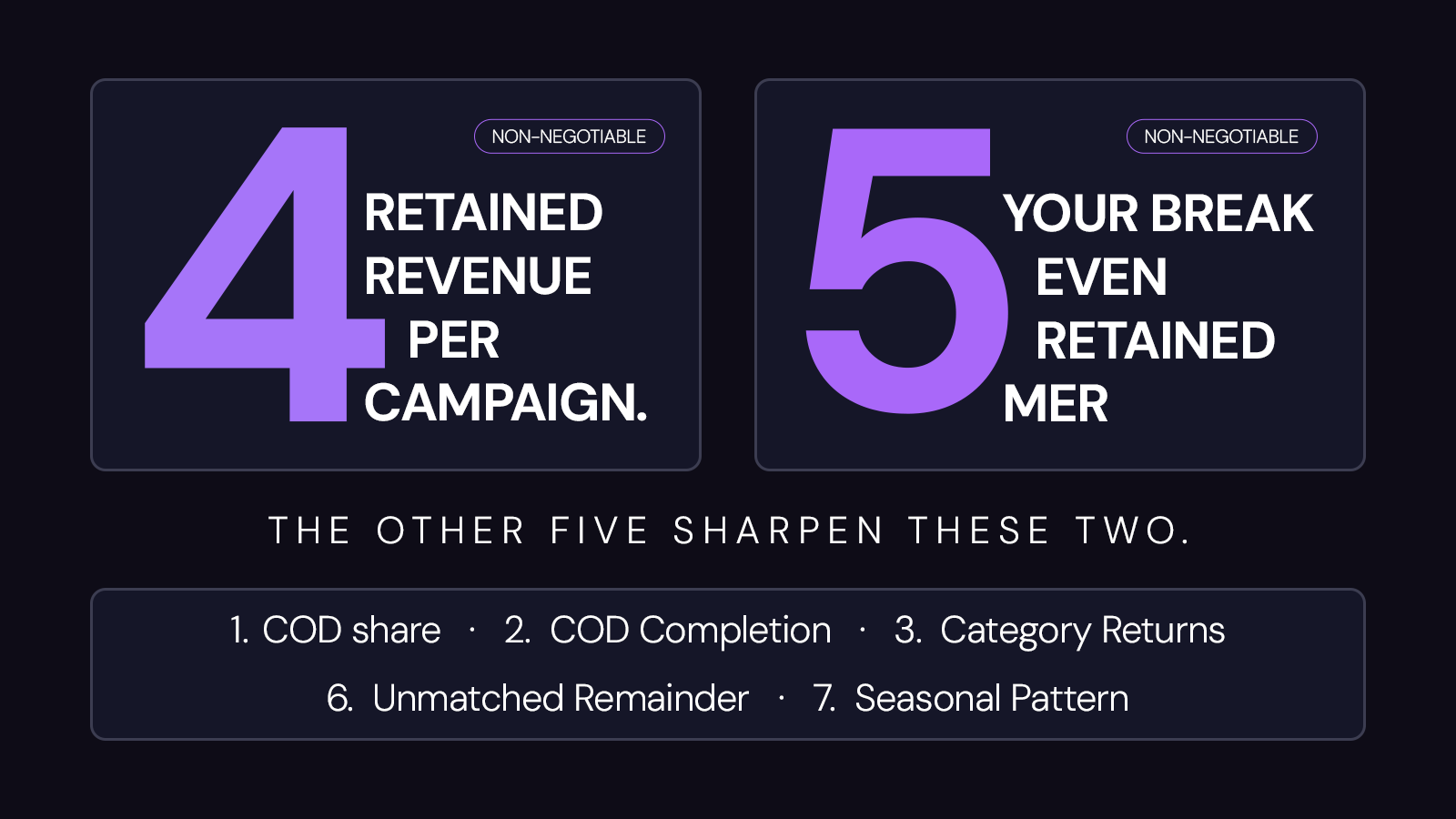
A brand that fails item 4 or 5 isn't ready to scale, no matter how good the platform ROAS looks.
Of the COD orders you place, how many actually get delivered and paid for. Different number from your COD share, and it's the one that turns a COD order into real revenue or a dead parcel.
Pull it this week: COD orders delivered and paid, divided by COD orders placed, same period. The market benchmark: COD orders ran 58% RTO during the November 2025 festive quarter against under 15% for prepaid, easing to a blended 21% by early 2026 (Unicommerce, FY2026). Flip that around and completion sat close to 42% at the festive peak, roughly 79% blended the rest of the year. That's the market, not your account, the full RTO picture is here.
The trap: budgeting off the market number instead of measuring your own.
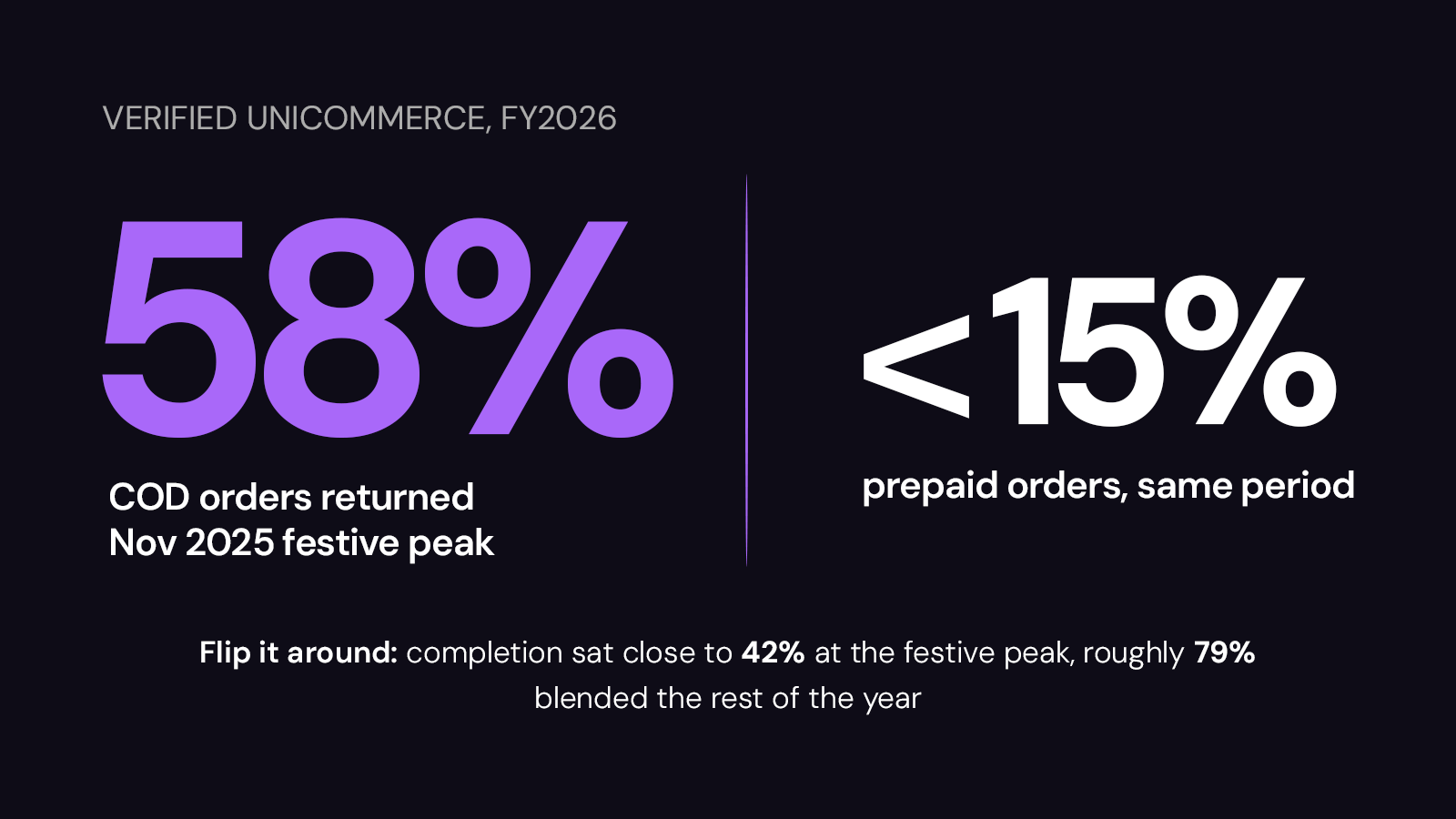
That's the market. Run your own number before you scale on it.
A different leak from RTO. RTO is a delivery that never happens. A return is a delivered order that comes back inside the return window, size, fit, or expectation, not usually a broken product.
Pull it this week: returned units divided by delivered units, by category, for a period where the return window has actually closed. Pull it too early and you'll undercount.
The trap: treating RTO and returns as the same leak and only budgeting for one. Fashion and apparel run structurally high on this regardless of payment method, but the method above works with your own data right now.
Blended account ROAS hides concentration. One campaign can carry most of your account's COD risk while reporting the best number on the dashboard.
Pull it this week: run each campaign you're about to scale through Adverti's true ROAS calculator, campaign-level COD share and failure rate in, retained ROAS out. Meta's reported number misses at the account level, just applied one campaign at a time.
The trap: scaling the campaign with the best reported ROAS without checking whether it's also your highest-COD, highest-RTO campaign.
Not an industry number, yours. It depends on your margin, your COD share, and your return rate, which is exactly why a benchmark you found online doesn't transfer to your account.
Pull it this week: Adverti's break-even MER calculator takes your margin, COD share, failure rate, and return rate, and gives you the MER where you actually turn a profit, reported and retained. The formula behind it, and why retained revenue is the input that matters, is in the Retained MER article.
The trap: chasing a reported MER that clears whatever number everyone else quotes, while your actual break-even sits higher. There is no good MER. There is your break-even.

Not an industry number. Yours.
Some orders won't match to a campaign no matter how carefully you reconcile, no click ID, no campaign parameter, nothing to join on. That's normal. What's not fine is quietly forcing them into whichever column makes the total look cleaner.
Pull it this week: when you match store orders against platform data, count what's left over. That leftover pile has a name, the unmatched remainder, and its size tells you something real about your own tracking hygiene.
The trap: a scale-up decision built on a reconciliation that hides its own gaps instead of stating them.
Whatever your numbers say today, they'll move if a festive push is coming. COD refusals and returns both climb during high-volume, high-first-time-buyer windows, that's not a guess, it's what already happened in the data above, COD RTO more than doubled its blended rate during the November 2025 festive quarter.
Pull it this week: check your own calendar. Is there a sale or festive push sitting inside your scale-up window.
The trap: setting a scale-up target off a calm-month completion rate the week before Diwali. We're not going to hand you a specific festival number that hasn't been verified yet, same discipline every figure on this page follows, so treat this one as a flag to budget looser during festive windows, not a percentage to plug in.
Passing doesn't mean every number comes back perfect. It means you know all seven, and you've priced the two that actually decide whether scaling works.
Items 4 and 5, retained revenue per campaign and your break-even Retained MER, matter most. A brand that fails either one isn't ready to scale, no matter how good the platform ROAS looks. The other five sharpen the picture, but those two are what tell you whether the math survives contact with your bank account.
This isn't a universal scale-up threshold, and none of the market figures above describe your account, they describe the market Unicommerce measured. Your own numbers, pulled with your own data, are what actually decides you're ready. Item 7 stays a flag instead of a figure on purpose, we're not citing a festival return rate that hasn't been verified, not on this page, not anywhere else on this blog.
Items 4 and 5 (retained revenue per campaign, break-even Retained MER) are the non-negotiables; the rest sharpen them. Scaling without those two means scaling a number you have not verified.
See your own estimated gap. Adverti Chat joins your ad spend with your store and delivery outcomes and shows a stitched estimate of what you actually kept, next to what was reported. Free plan, read-only access, no card.
Don’t miss our most popular and impactful reads.
Connect your Meta and Google accounts. Your first audit is ready in 30 seconds. Free forever on the Free plan.
We use cookies to keep Adverti working, understand how the site is used, and measure our ads. You can accept all, reject all, or choose what you allow. Read more in our Cookie Policy.