7/17/2026
Ad MeasurementMERD2C
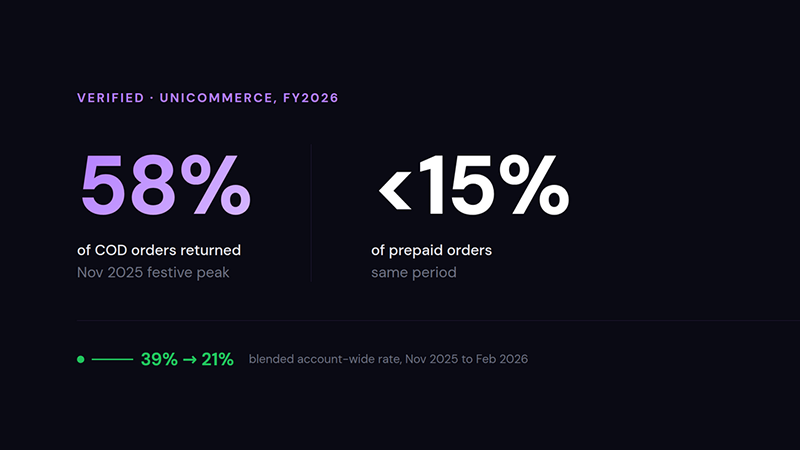
Verified data puts Indian D2C RTO at 58% of COD orders during the November 2025 festive quarter, against under 15% for prepaid orders (Unicommerce, FY2026), easing toward 21% blended by early 2026. Budgeting for RTO means two lines: the logistics cost of the returned parcel, and the measurement correction to the ROAS that still counts it as revenue.
Unicommerce's India D2C Report 2026 puts RTO at 58% of COD orders during the November 2025 festive quarter, against under 15% for prepaid orders. The platform-wide blended rate, across both payment types, ran near 39% at that same festive peak and eased to around 21% by early 2026 (Unicommerce, FY2026). That is a seasonal read, not a fixed annual rate. Festive volume pulls in more first-time buyers and more COD, and both raise refusal risk, so RTO climbs into the festive window and falls back once that order cohort clears the returns cycle. Category sits on top of that seasonal swing: fashion and apparel, where size, fit, and colour drive refusals that have nothing to do with a faulty product, sit at the high end of any range reported for Indian D2C; categories with lower COD share and more considered purchases, like electronics and beauty replenishment, sit lower. A single number describes the market. An account has its own.
Source: Unicommerce, India D2C Report 2026.
Every returned parcel costs money before it ever reaches a spreadsheet: the forward shipping already paid, the reverse shipping back to origin, repackaging or relabelling if the product is resalable, and the write-off if it is not. Most Indian D2C finance teams already carry this line, usually folded into logistics or fulfillment cost, because the courier invoice makes it impossible to ignore.
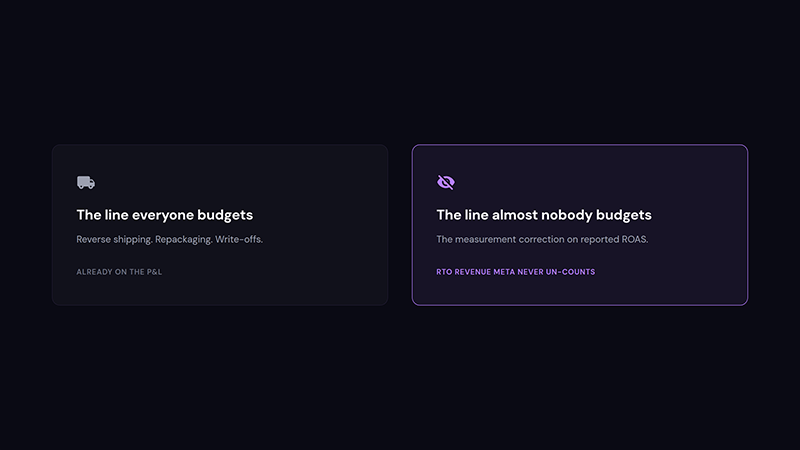
Most teams already budget the shipping cost. Few budget the measurement correction.
The line most founders skip is not a cost at all. It is a correction. Meta and Google count the sale the moment the pixel fires, and an RTO parcel that comes back weeks later never sends a signal back to either platform, so the reported conversion stays counted as revenue permanently. That gap between what a platform reports and what a brand actually keeps is the Reality Gap, and RTO is one of its structural leak points, not a one-time distortion that washes out over a quarter. Budgeting for RTO without budgeting for this correction means a campaign can hit its reported target the same month it misses its retained target, covered in full in why Meta reports higher ROAS than your actual revenue.
The workable version of this is not a market-wide percentage. It is your own COD completion rate applied to your own campaign-level reported revenue before a target gets set. Adverti's true ROAS calculator runs this adjustment directly: ad spend, reported revenue, COD share, COD failure rate, and return rate in, the revenue gap in rupees out. Pull COD orders placed against COD orders actually delivered and paid for a period, apply that completion rate to the reported revenue a campaign claims, and the campaign's honest target moves before the month starts rather than getting explained away after it ends. This matters most at the campaign level because blended, account-wide RTO hides concentration: a handful of high-reported-ROAS campaigns skewed toward COD-heavy geographies or a single high-return category can carry most of an account's RTO while every other campaign looks clean, the same way payment mix distorts reported ROAS more broadly.
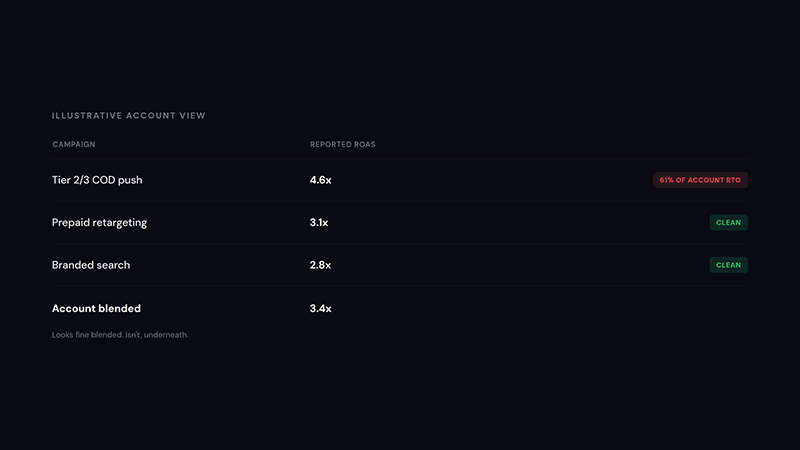
Illustrative example. A blended account number can hide one concentrated, high-return campaign.
Every figure on this page describes the market Unicommerce measured across FY2026, not any single brand's account. A brand with tight pincode-level COD restrictions, a prepaid-incentive program, or a low-return category can sit meaningfully below the 21% blended low point. A brand new to COD in Tier 2 and Tier 3 expansion during a festive push can sit above the 58% COD-specific peak. Use the range to sanity-check a number that looks wildly off, not to set a target. The target comes from a brand's own COD completion rate, measured continuously, not from a market average measured once a year.
No. RTO (return to origin) is a delivery failure, the parcel never successfully handed over, dominated by COD refusals. A return is a delivered order sent back afterward. Both leak revenue; they leak at different stages and for different reasons.
See your own estimated gap. Adverti Chat joins your ad spend with your store and delivery outcomes and shows a stitched estimate of what you actually kept, next to what was reported. Free plan, read-only access, no card.
Don’t miss our most popular and impactful reads.
Connect your Meta and Google accounts. Your first audit is ready in 30 seconds. Free forever on the Free plan.
We use cookies to keep Adverti working, understand how the site is used, and measure our ads. You can accept all, reject all, or choose what you allow. Read more in our Cookie Policy.