8/7/2026
Ad MeasurementD2CRTO
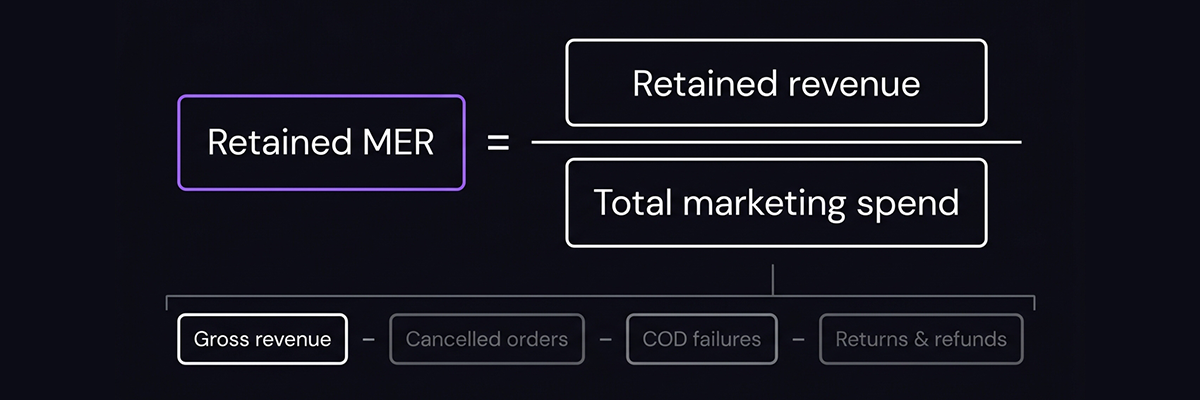
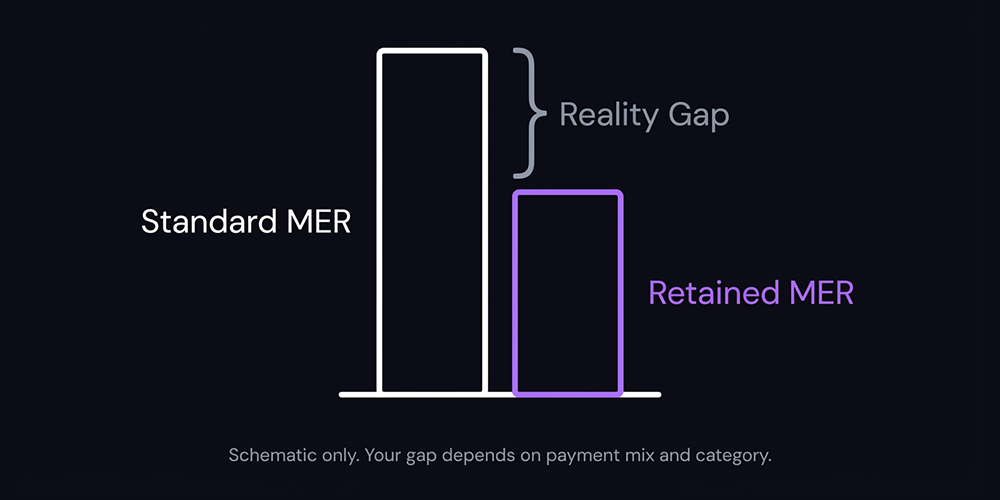
Retained MER (Marketing Efficiency Ratio) is total retained revenue divided by total marketing spend, where retained revenue means revenue remaining after cancellations, COD failures, and returns are removed. It differs from standard MER, which uses platform-reported or gross revenue and therefore inherits the Reality Gap.
MER is the blended efficiency ratio: total revenue divided by total marketing spend across all channels for a period. Unlike campaign-level ROAS, it ignores attribution disputes entirely, which is why finance teams tend to trust it more. Its weakness is inherited from its input: if the revenue figure is gross or platform-reported, MER carries every uncorrected cancellation, COD failure, and return inside it.
Retained MER = retained revenue / total marketing spend, for the same period.
Retained revenue = gross revenue minus the value of cancelled orders, minus the value of COD orders refused or undelivered, minus the value of returned and refunded orders. Exchanges that hold revenue (size swaps) stay in; refunds leave. Spend means all marketing spend for the period: platform ad spend, agency or freelancer fees, and tools, so the ratio answers the question a founder is actually asking.
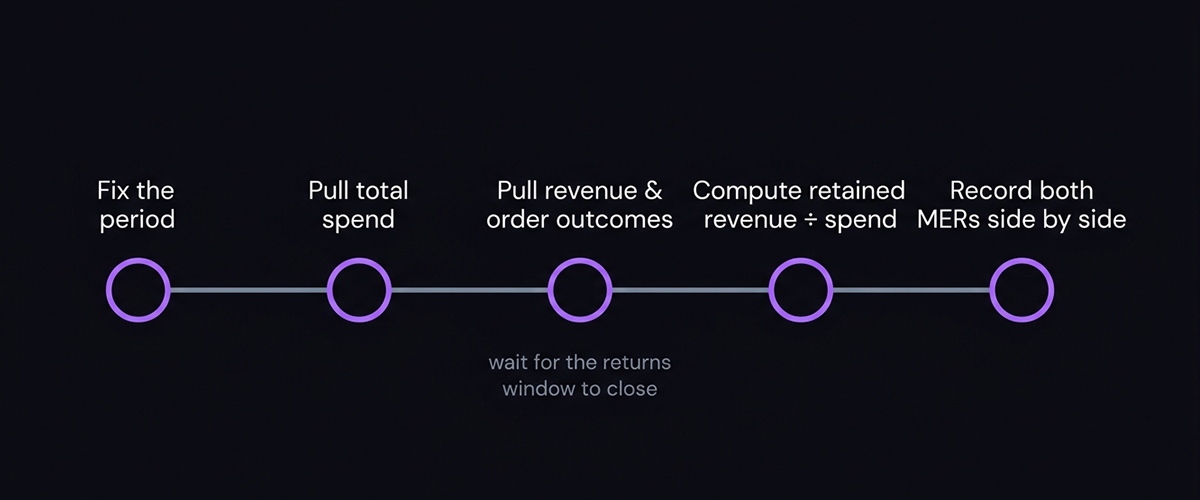
One: fix the period, a calendar month is standard. Two: pull total marketing spend for the period from every channel. Three: pull gross revenue and order outcomes from the store, cancellations, COD completion, returns and refunds, allowing the returns window to close before finalising (a month's Retained MER is honestly computable only after its returns window ends, the same period-end discipline behind the month-end close for ad spend). Four: compute retained revenue and divide by spend. Five: record both numbers, standard MER and Retained MER, side by side; the distance between them is your Reality Gap expressed as a ratio.
The benchmark that matters is not an industry average, it is your own break-even: the Retained MER at which contribution turns positive given your margin structure. Because it depends on your COD share, your category return rate, and your unit economics, nobody else's number transfers. The full framework for computing it has its own article.
Retained MER is blended by design: it will not tell you which campaign or channel to cut, only whether the whole engine kept enough of what it reported.
Pair it with campaign-level analysis on stitched data for the cutting decisions. And a Retained MER computed from an estimated join is itself an estimate; label it as one until order-level reconciliation hardens it.
It is close to what some teams call net MER, with one insistence: the deductions are the post-click failures (cancellations, COD failures, returns), defined explicitly and consistently. Contribution MER usually goes further and deducts COGS and shipping; Retained MER stops at revenue actually kept, which keeps it a marketing metric rather than a P&L line.
See your own estimated gap. Adverti Chat joins your ad spend with your store and delivery outcomes and shows a stitched estimate of what you actually kept, next to what was reported. Free plan, read-only access, no card.
Don’t miss our most popular and impactful reads.
Connect your Meta and Google accounts. Your first audit is ready in 30 seconds. Free forever on the Free plan.
We use cookies to keep Adverti working, understand how the site is used, and measure our ads. You can accept all, reject all, or choose what you allow. Read more in our Cookie Policy.