7/17/2026
Ad MeasurementMERD2C

Fashion D2C has the widest gap between reported and retained revenue because it stacks three factors: structural returns, a high COD share, and thin per-order margins. Festive-season COD returns ran 58% industry-wide (Unicommerce, 2026), with fashion at the sharp end, so the same reported ROAS retains less in fashion than in any comparable category.
Start with returns. Festive-season COD returns ran 58% industry-wide (Unicommerce, 2026), and fashion sits at the sharp end of that, above the cross-category average. These returns are not the occasional defective unit. They are a standing share of every cohort, and each returned order that gets refunded removes revenue the ad platform already counted and will never uncount.
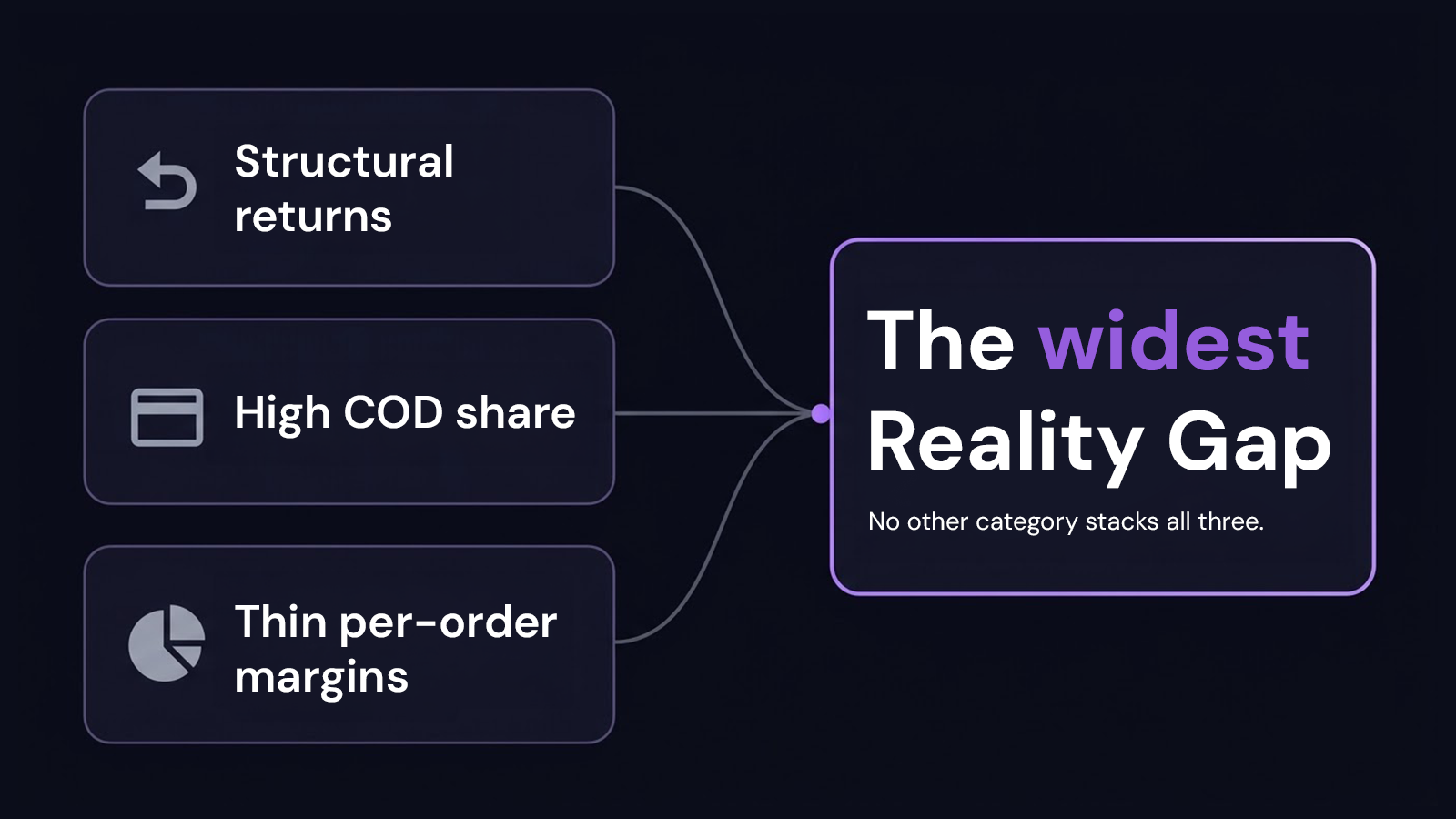
Fashion is the only major Indian D2C category that stacks all three at once: structural returns, high COD share, and thin margins. Together they open the widest gap between reported and retained revenue.
On top of that, fashion runs a high cash-on-delivery share, and every COD order carries a doorstep veto the pixel cannot price: the parcel can travel the whole way and still come back unpaid. COD refusals and post-delivery returns are separate leak points, but they stack, and fashion is heavily exposed to both.
The third factor is margin. Fashion tends to run thin per-order contribution once product cost, shipping, and the reverse-logistics cost of a return are subtracted. Thin margins mean the same percentage of lost revenue bites harder: a category with fat margins can absorb a return, fashion often cannot. Stack a high return rate on a high COD share on a thin margin, and you get the widest distance between what the platform reported and what the brand kept. That distance is the Reality Gap, and in fashion it is structurally larger than anywhere else.
The returns are not a quality problem, and treating them as one sends founders to fix the wrong thing. Apparel and accessories come back because of size, fit, colour on screen versus colour in hand, and the plain fact that a buyer often orders two sizes intending to keep one. None of that is a defect. It is how the category is bought. A fashion brand with excellent products and honest listings will still see returns that a supplements or electronics brand never will, and no amount of product improvement drives that number to zero.
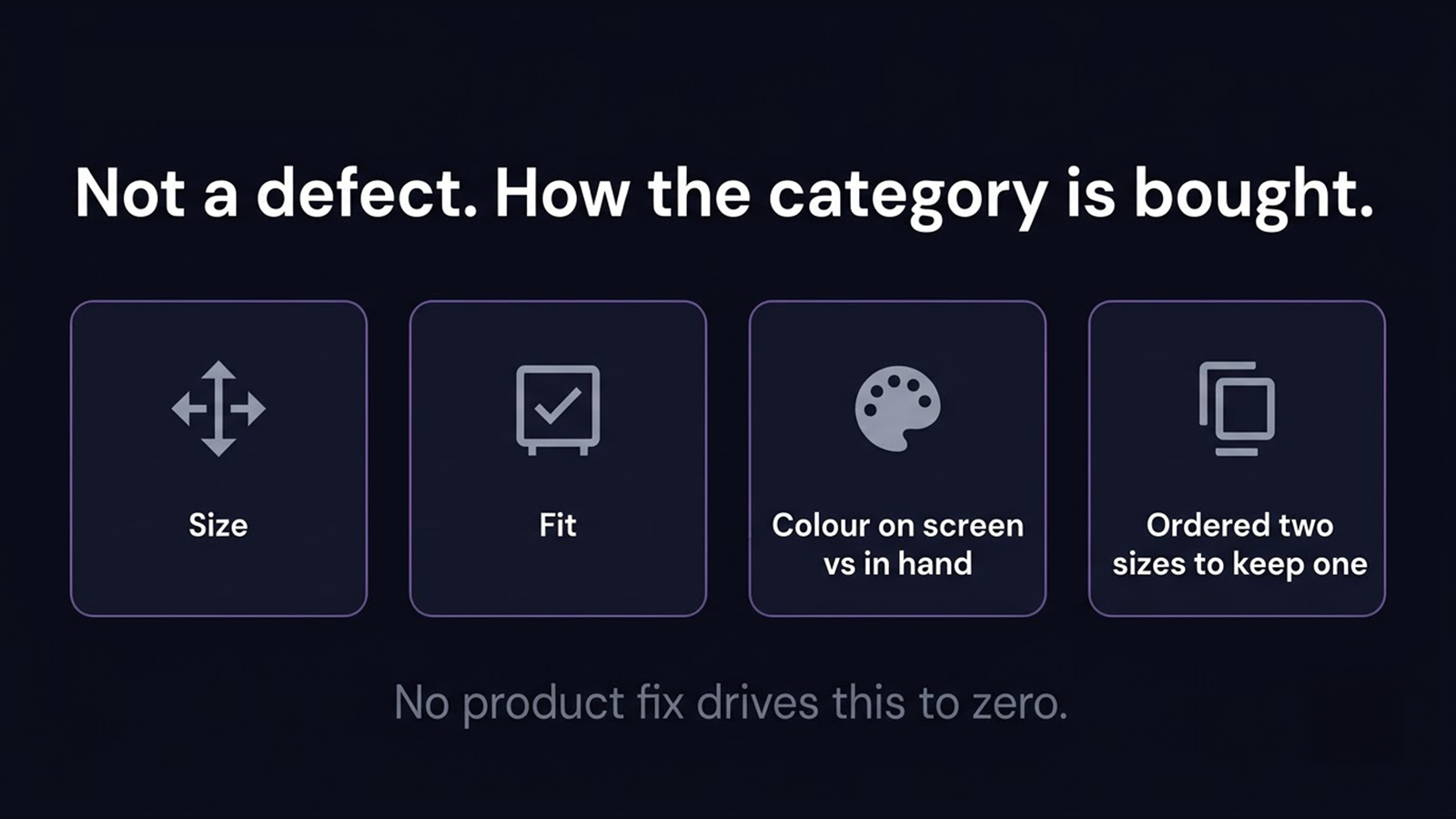
Apparel comes back for size, fit, colour, and expectation, not defects. A brand with excellent products and honest listings still sees returns a supplements or electronics brand never will.
The practical consequence is that the reported number on a fashion dashboard is less true than the same number on a dashboard in a lower-return category. The same reported ROAS in fashion and in a prepaid, low-return category are not the same money, because more of fashion's reported revenue evaporates after the click. Planning next month's budget on the reported figure therefore overstates fashion's real efficiency by more than it would almost anywhere else. The fix is to measure the divergence for your own account rather than guess at it: the method for adjusting reported ROAS for COD failures and returns is covered in why Meta reports higher ROAS than your actual revenue and in how to calculate true ROAS after returns and COD failures.
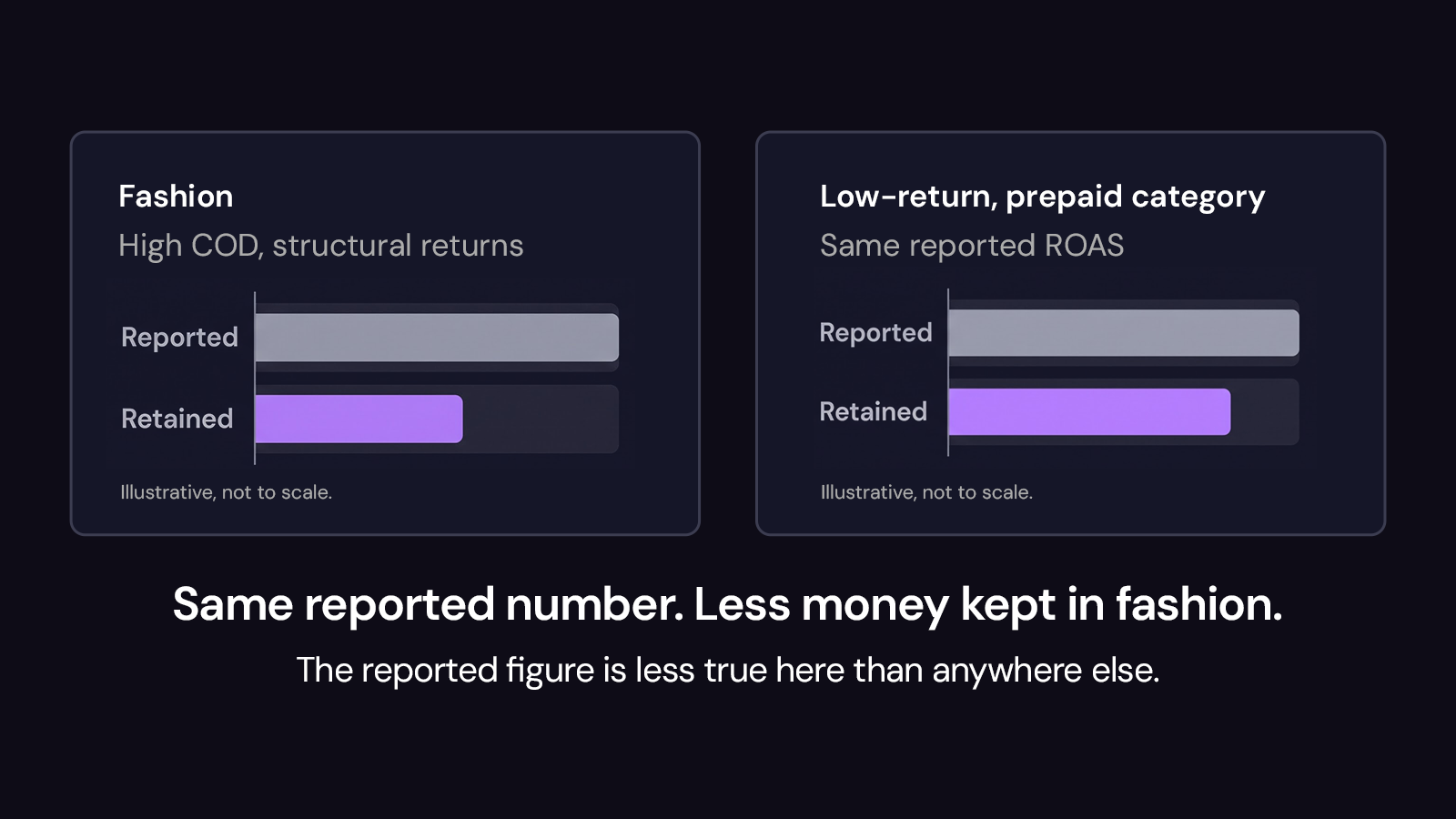
The same reported ROAS is not the same money. More of fashion's reported revenue evaporates after the click, so planning on the reported figure overstates fashion's real efficiency by more than in any other category. Illustrative, not to scale.
Adverti Chat is built for this category first precisely because its gap is the widest, which is exactly where an honest number is worth the most.
This page describes a category, not your brand. Category data from a source like Unicommerce tells you where fashion sits on average. It does not tell you your return rate, your COD completion, or your margin, all of which are measurable in your own store and delivery data and may differ sharply from the category line. A well-run fashion brand with disciplined sizing guidance and a prepaid-skewed audience can sit far below the category average, and a poorly run one far above it. The category number is the reason to measure. Your own number is the thing to act on.
No, COD is often where fashion's growth lives. The move is measuring retained revenue by payment type and campaign, then deciding with numbers, covered in the [COD article](/blog/cod-and-roas-indian-d2c).
See your own estimated gap. Adverti Chat joins your ad spend with your store and delivery outcomes and shows a stitched estimate of what you actually kept, next to what was reported. Free plan, read-only access, no card.
Don’t miss our most popular and impactful reads.
Connect your Meta and Google accounts. Your first audit is ready in 30 seconds. Free forever on the Free plan.
We use cookies to keep Adverti working, understand how the site is used, and measure our ads. You can accept all, reject all, or choose what you allow. Read more in our Cookie Policy.